[ 05 ] Predictive ML · Research prototype
SHPSv2
A predictive asset-management prototype that turns structural sensor inputs into remaining-life estimates, deterioration forecasts, and feature explanations.
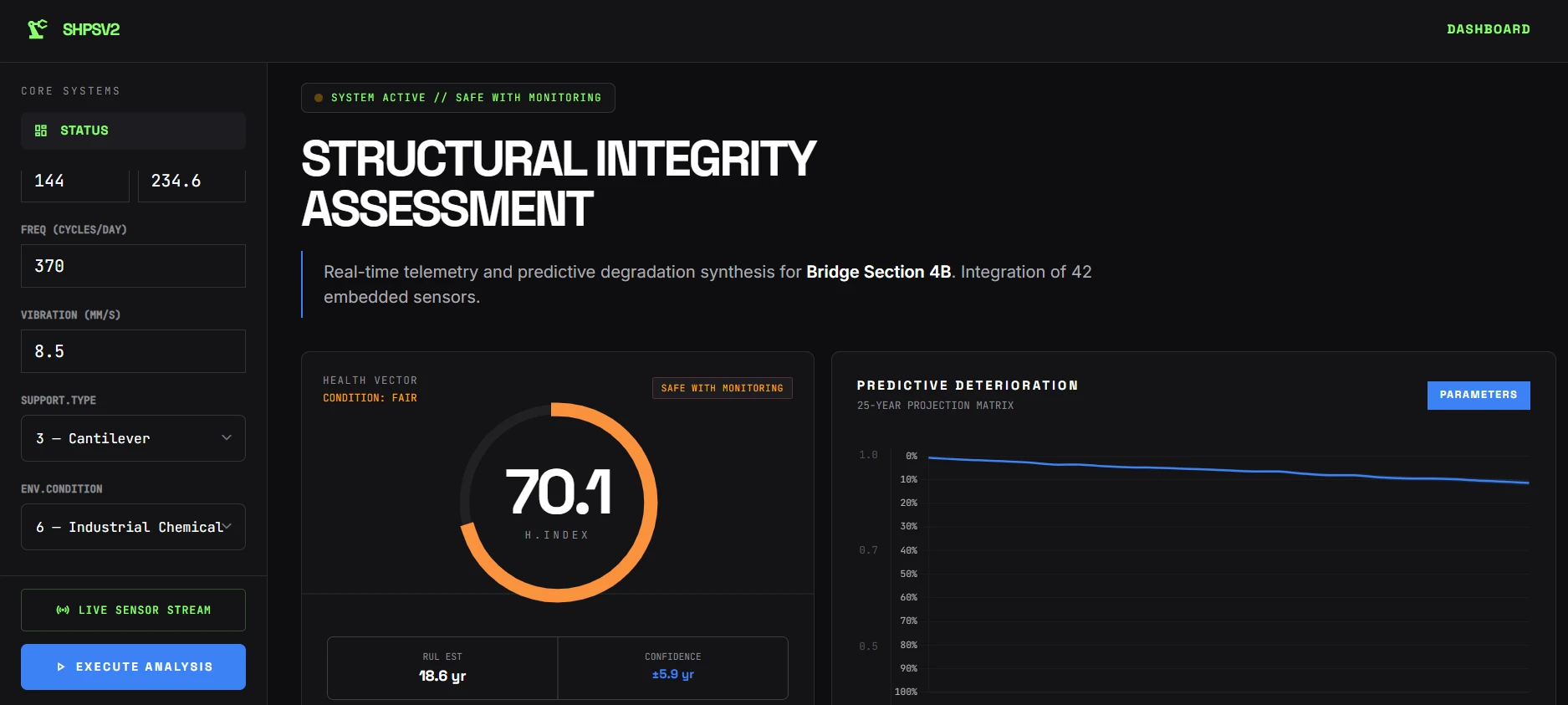
Nine sensor inputs feed physics-informed validation, XGBoost health and remaining-life models, an independent 25-year LSTM forecast, SHAP explanations, and a PDF report.
Inside the build
Quantile Regression Committee
Instead of a single point estimate, three XGBoost models are trained at quantiles [0.025, 0.5, 0.975] — producing a calibrated 95% confidence interval for Remaining Useful Life (R² 0.98). The interval biases maintenance toward earlier, safer interventions rather than optimistic single-value predictions.
Temporal Forecasting (LSTM)
A separate Keras/TensorFlow LSTM generates a 25-year deterioration forecast with a confidence band. It is independent of the XGBoost health-score and remaining-useful-life models.
Physics-Informed Feature Engineering
Nine sensor inputs become 14 physics-informed features, including stress, fatigue, and degradation indices. The health-score XGBoost model and the LSTM forecast use these features in separate pipelines, so an error in one prediction does not feed into the other.
Physics Guardrail (Pydantic v2)
Pydantic v2 model_validator checks cross-field physics rules before inference. The README gives examples such as a load above 4,000 kN with low concrete grade, or a cantilever load above 2,500 kN.
SHAP Latency Fix — KMeans Centroid Compression
At startup, KMeans compresses 10,000 rows of training data into 100 centroids, which SHAP uses as its background set. The README reports interventional SHAP inference under 50 ms per request.
Health score, what-if analysis, and report
The XGBoost health-score model reports R² 0.89. The UI can vary one input to show its effect on that score, and it generates a PDF audit report with charts, SHAP analysis, and a maintenance roadmap.
Deployment
A multi-stage Docker/Podman image uses tensorflow-cpu and a non-root user, served with Gunicorn. The Hugging Face Spaces demo exposes the dashboard, including what-if simulation and a server-generated PDF audit report.